20 October 2011 | Categories: Study Groups
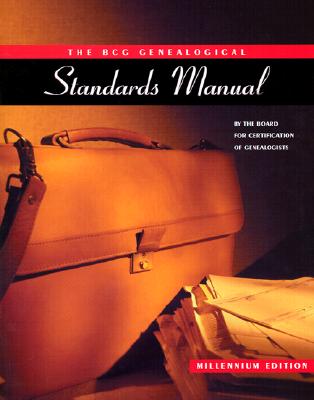
The BCG Genealogical Standards Manual

The BCG Genealogical Standards Manual

In this second post about the Second Life Genealogy Book Club discussion of Val D. Greenwood’s The Researcher’s Guide to American Genealogy (3rd Edition), I offer a tangent that lists the Board for Certification of Genealogists (BCG) version of evidence analysis to compare and contrast a few key points.  Here’s the link to the post detailing Greenwood’s evidence types while the book club continues on through other chapters of that book.

Categories Standards
Data Collection 1-18
Evidence Evaluation 19-34
Compilation 35-56
Lecturers 57-60
Instructors 61-66
Educational Writers 67-72
Continuing Education 73-74

Mentioned briefly in Greenwood’s book, in 1997, BCG discontinued the use of the “preponderance of evidence” standard and adopted a list of seventy-four standards collectively named the Genealogical Proof Standard (GPS), numbered and categorized in groups.

For this post, I’ll only quote from standards 21, 22, and 29, though others among the “Evidence-Evaluation Standards” go into further details about background context, relevance, inconsistencies, and other issues that certainly fine tune how we treat the information we find.  Here I’m bringing up contrasts to the types of evidence in Greenwood’s list compared to the GPS method.

Greenwood’s list of evidence types included “direct”, “circumstantial (or indirect)”, “primary”, “secondary”, “collateral”, and “hearsay”.  Four of these have matches in the GPS method, separated between pairings for sources and evidence, while the third pair I tend to include within “circumstantial” or “secondary”.

The GPS lists three main pairings — sources, information, and evidence — as distinct areas to analyze.

“21. Data analysis includes distinguishing between original and derivative sources, which are defined as

original source: the person or record whose information did not come from data already spoken or written. [...]

derivative source: a person or record that supplies information that is repeated, reproduced, transcribed, abstracted, or summarized from something already spoken or written.” (BCG, 8-9)

Only the original hand-written or typeset records or recordings (audio or video) are considered original sources in this standard.  All others may have various levels of derivative nature.

While most of us only have access to photographic reproductions of the original records, these do not always include every piece of information in the true original.  Think of microfiche newspaper archives where corner or edge articles are distorted, cut off, or blocked by vignetting during the imaging process.  When originals have been annotated with other inks or pencils, black-and-white photos or scans can make those distinctions difficult to decipher.

Another example came in a chat with Colleen Method (aka Kilandra Yeuxdoux in Second Life) from the Virtual Museum of Victorian Era Ephemera site and blog.  Even the best photos do not do the pieces full justice when not only are some cards pre-printed with a faux-curled edge while others are actually curled or folded to show personal visits, but also that at least one bottle-shaped perfume sample card still retains a trace of a sample scent.  Also the material texture of some distinguish them.

Further generations of derivatives are more obvious.  Articles printed in the news have usually been edited for content, style, length, or unfortunate introduced errors, and can be different than the original submitted manuscript.  Reprints, transcriptions, and other verbatim copies can introduce errors.  And abstracts or brief notes lose information deemed not relevant to the note taker at the time.

These were mentioned within Greenwood’s “primary” and “secondary” evidence types, but are separate in GPS as evaluating sources, because both types of sources can contain both primary and secondary information.  A signed signed death certificate (original source) and its database transcription (derivative source) may both contain a Doctor’s declaration of death and medical reason (primary information) and the person’s age (secondary information).

Once the source itself has been categorized, the information it contains is investigated.

“22. Data analysis includes distinguishing between primary and secondary information, which are defined as:

primary information: data contributed by a knowledgeable eyewitness to or participant in the event that is the subject of the record or by an official whose duties included making a full, accurate record of it. [...]

secondary information: data supplied a person who recorded it after hearing of the event or its details from someone else.” (BCG, 9)

I think the “official duties” concession here can be problematic.  Census enumerations are a classic example where Enumerators, each “an official”, recorded names phonetically because they were not privy to primary information on the names or ages.  In one specific example, I have a step-2nd-great-grandfather listed with the first given name “John” for all records (including his own signatures) other than one Census enumeration that lists him as “James” with a five-year age discrepancy, and with some alternate spellings of the Germanic “Schmidt” surname over the enumerations.

In that way, “official record” may be one of the exemptions to the “hearsay” rule that Greenwood mentioned, but it does not automatically make the information “primary” or even necessarily correct.  But dealing with contradictions in more detail can wait for a future post.

When the source and information are looked at in this detail, we can decide to use it as a form of evidence:

“29. Direct and indirect evidence is correlated with the question being investigated. [...]

direct evidence: an evidence item that is adequate by itself to answer the question. Direct evidence answers the question at hand, but does not answer every question. [...]

indirect evidence: an evidence item that is incomplete in itself and therefore inadequate to answer to the question at hand.” (BCG, 11-12)

This directly matches Greenwood’s pairing of “direct” and “circumstantial (or indirect)” evidence.

This has practical use in recent genealogical software.  I’ve been using RootsMagic 4, and it references this three-way analysis directly with their options for citation quality (though they list it as information quality) — select a fact within an individual’s Edit window, click ‘Sources’ (alt-S), select a source citation, click ‘Edit’ (alt-E), then click ‘Quality’ (alt-Q):

RootsMagic 4 Source Quality Options

RootsMagic 4 Source Quality Options

One additional evidence option is shown, “Negative: This source is missing information that it should include”.  I use this two ways:

  • If the research question is “In what country or state was John Schmidt born?”, and a source that has an available line for that information was left blank, then that source is not evidence to answer that question.  That it should have answered it makes it “negative”, or missing, evidence.  This might be resolved by finding sources and information elsewhere.
  • If the question is “What was the name of Herman Schmidt’s father?”, and all sources but one include primary or secondary information, directly or indirectly, that his name was John Schmidt, but one lists secondary information of the name as James Schmidt, then that source is “negative”, or contradictory, evidence.  This may be resolved by weighing all the evidence and their varied levels of credibility.

Obligatory citation: The Board for Certification of Genealogists. The BCG Genealogical Standards Manual: Millennium Edition. New York, NY: Turner Publishing Co., 2000.

(No Ratings Yet)
15 October 2011 | Categories: Study Groups
Researcher's Guide to American Genealogy cover

Researcher's Guide to American Genealogy

Recently the Genealogists on Second Life community started a book club, choosing to study Val D. Greenwood’s The Researcher’s Guide to American Genealogy (3rd Edition) a chapter at a time.  For the first two meetings, we went discussed two chapters at a time, monthly, but we’ve currently shifted to one chapter per week.

One early chapter that prompted extra discussion of semantics was Chapter 4, “Evaluation of Evidence.”  The evidence types and definitions seem based on the legal standards, and many seemed obvious, some some included a few head scratching moments. It’s a different set than that used in the Board for Certification of Genealogists’s “Evidence Evaluation Standards” (from The BCG Genealogical Standards Manual). The types of evidence and their basic definitions from Greenwood’s book begin with:

A. Direct Evidence [...] evidence (or information) which, standing alone, tends to show the existence of a fact. It is evidence that relates directly to a precise issue. (Greenwood, 67)

B. Cicrumstantial Evidence [...] (or indirect evidence) [...] is evidence or information about facts and/or circumstances from which the existence (or non-existence) of a fact at issue may be inferred. (Greenwood, 67)

These two seem obvious enough.  A few examples:

  • A marriage certificate, for example, states the names of the bride and groom, date, and location of a marriage, and is therefore direct evidence that that marriage was performed by the signing officiator of the certificate.
  • However, a marriage license, while direct evidence of the intent and legal right to marry, would only be circumstantial evidence of an actual marriage–they still could have backed out.
  • An early Census record listing two people in one household as each being married (but not listing the relationship between them) would be primary evidence of their census enumeration, but circumstantial evidence of their residency on that date and of their being married to each other; the enumerator may have been taking one of the residents’ word for the residency of the others without witnessing it himself.

C. Primary Evidence [...] is generally original or first-hand evidence. It is found in original documents such as an original will, an original pension application, an original deed, or an original tax receipt. We also consider photographic reproductions of these records, including microforms and photocopies of these documents as primary evidence. Though we seldom see true original documents in genealogical research if we are working beyond the second or third generation from ourselves, we use photo-reproductions of these records as if they were the originals. (Greenwood, 68)

I quote this one in more detail, because by combining “primary” and “original”, there’s a conflict with the BCG standard, which separates the evaluation of sources from the evaluation of evidence.

Many of us can attest that microfiche, photocopies, and digital scans, while often the easiest (and sometimes only) access to certain documents, can be obviously degraded compared to the actual original documents.  I’ve definitely come across my share of too-saturated (or not-saturated-enough) documents among microfiche archives. And even some original documents, such as early Census enumeration sheets, may have been recorded phonetically by someone not “primary” to the information.  This would make them:

D. Secondary Evidence [...] is evidence that is not primary. [...] It includes evidence obtained from transcribed or copied materials (including old “recorded” wills and deeds), from extracts of records, from compilations of information gathered from all kinds of sources, and from published sources. (Greenwood, 69)

The final two types of evidence listed brought the most discussion in the book club.

E. Collateral Evidence [...] is evidence that is an integral part of the source record in which it is found but has nothing to do with the reason that the record exists. (Greenwood, 71)

It’s a semantic point, but sometimes the difference between “Collateral” and earlier types such as “Circumstantial/Indirect” is only the question being asked.  Greenwood’s examples of this type (with my possible recategorizations depending on the research question) were:

  • an ancestor’s relative mentioned in a deed as the person who had transferred the land in an earlier transaction (not evidence at all of the current transaction, but secondary evidence of the transfer of ownership in the earlier transaction), and
  • a birth date listed on a death certificate (not evidence of the death, but secondary evidence of the date of birth).

F. Hearsay Evidence [...] is any evidence that is outside of the personal knowledge of the source that reports it. The term applies to written information as spoken information. Thus, virtually all evidence used in genealogical research is hearsay evidence. This is true because the source of the information reported, insofar as we are concerned, is the document or record in which that information is found. Because that document has no personal knowledge of the reported event (or of anything else for that matter), all documentary or recorded evidence is hearsay evidence. (Greenwood, 71)

This category drew some head scratching among us, as the same documents that were listed as “originals” and “primary” earlier would be considered here as “hearsay” simply because they are documents.  Greenwood does list some exceptions to the legal hearsay rules, such as official record, authenticated documents, and others, but writes that the more important issue is whether the document is relevant, and deciding how much weight to give it based on primary-vs-secondary or direct-vs-circumstantial considerations (p.72).

After discussing these categories of evidence, Greenwood touched on the history of genealogists changing from following a “preponderance of evidence” format to BCG’s “Genealogical Proof Standard” (GPS).  Part of this standard is a different set of source and evidence considerations not directly mentioned in Greenwood’s chapter about evidence.  I’ll discuss those next time.

Obligatory Citation: Greenwood, Val D. The Researcher’s Guide to American Genealogy: 3rd Edition. Baltimore, MD: Genealogical Publishing Co. Inc., 2000 (Fifth printing, 2005).

(No Ratings Yet)
04 October 2011 | Categories: Uncategorized

The report of my absence from the blog is a dull but busy affair. A bout of employment, the business of seeing further employment, and other temporary issues kept me thinking about posting publicly, but away from taking the time to do so. It wasn’t much of a vacation. But it’s time to settle the itch of updating the blog, and to bring up some interesting exercises from my own research, which continued as it always does when given a chance.

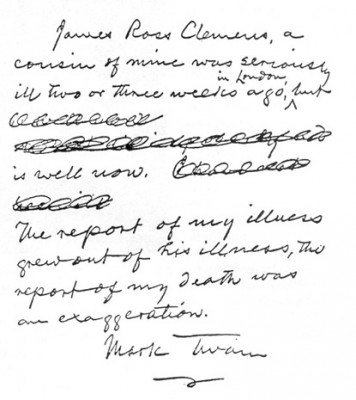
In keeping with the “Scribbled” theme of family history (but not mine in particular), I offer a reminder from May 1897 to not treat obituaries as proof without further evidence:

Twain Exaggeration, 1897

“James Ross Clemens, a cousin of mine was seriously ill two or three weeks ago, in London, but [scribbled deletion] is well now. [scribbled deletion]

“The report of my illness grew out of his illness, the report of my death was an exaggeration.”
[signed] Mark Twain

(No Ratings Yet)
14 March 2011 | Categories: Blog Prompts
"Doing Research" (cc) by Viewoftheworld at Flickr

"Doing Research" (cc) by Viewoftheworld at Flickr

I’ve slacked a bit on the blog front, but a few motivational things have been pushing forward at the same time:

WDYTYA? — While NBC is currently rerunning some of the Season 2 episodes of the US edition of Who Do You Think You Are?, I’ve been watching my own DVD reruns of some favorite BBC editions, such as:

  • Robert Lindsay, of “My Family”, “G.B.H.”, and “Citizen Smith”, who found (or was shown) the burial record for an aunt who died in infancy on the anniversary of the burial, and followed the family story of a grandfather who had been “blown up twice” in WWI, tracing his service to Gallipoli, an eye-witness diary of the event, and an underwater wreck of a boat that matched the description (though many others may have been sunk similarly).
  • John Hurt, of The Elephant Man, Midnight Express, and Alien, armed with an affinity for Ireland and family lore about an ancestor’s titled lineage that proved untraceable at best or fraudulent at worst. But genealogical proof is not required to continue feeling an affinity to one’s own home.
  • Colin Jackson, World Record and Olympic Medal holder in hurdles, started with a DNA test before heading to Jamaica to trace an ancestor who was born into slavery and became a land owner, and another via Panama whose body was exhumed and reburied in a community grave after no relatives could be contacted to continue paying for her original plot.

If you have the ability to play European Region-2 DVDs (either a spare DVD-ROM that can be set to that region or a Region-Free player1), the BBC series/seasons are highly recommended. They are deeper than the first season of the US edition, as they lack the repeated “coming up” and “recap” clips, and often include BBC stock footage of appropriate historical context.

Business Planning — My local state and city laws require business licenses to do anything “for gain, profit or advantage”, so I’ve been plugging away at those before listing a services page here.  Since I also live in a state with a sales tax, which also applies to “digital” works as well as the classic “tangible” goods, that’s another thing to pin down where needed.

Of course, some general business reading or genealogy podcast listening helps, too.  More on that next time.

Always More Names — One long-standing spare-time personal project has been to add information from three Norwegian bygdeboker (parish histories) from my paternal grandparents’ home parishes to my genealogy database. Two of these were my grandfather’s, and another (for my grandmother’s parish) was purchased through a Swedish used book store.

The busiest work is going through one that contains family-group genealogical information for a whole parish (with the occasional gap mentioned earlier). Lately I’ve been tackling that book a few full pages at a time instead of my older method of jumping around, recording only the individual families I was interested in at the time — and going back to a page when a “neighbor” entry turns out to be family, too. At best it’s a practice in delving into relevant-but-incomplete records, especially when compared to the next section.

Giving Back — Indexing Norwegian parish books for DigitalArkivet (The National Archives of Norway), at least for those I can reliably read, helps get these into searchable databases, and certainly adds to my own experience in transcribing for myself and others. And it helps when asked to look at the handwriting in books I haven’t had need to peruse until recently.

Another indexing project for those interested is FamilySearch Indexing, run by The Church of Jesus Christ of Latter-day Saints and their extensive Family History Centers.

1 While some of the BBC episodes can also be found on uploaded-video sites, I prefer to recommend supporting official releases; and since the BBC blocks video access to areas outside its realm, that usually leaves import DVD as the only officially available version.

(No Ratings Yet)
25 February 2011 | Categories: Television
Who Do You Think You Are? titlecard

Who Do You Think You Are? titlecard

As a long-time viewer of the BBC edition of Who Do You Think You Are?, which has broadcast sixty episodes over seven seasons so far1, I recognized tonight’s episode featuring Kim Cattrall as an edited version of a BBC episode from 2009 (Series 6).

As fans of PBS may be aware, hour-long BBC originals are aired with no commercial breaks, at about 55 minutes running time.  Since the American edition has the typical set of advertisements and brief “coming up” clips, it has a running time of under 50 minutes, requiring some edits to fit the shorter schedule.

The major differences in this episode were:

  • All narration was dubbed for continuity of using the same narrator as the other American episodes.  This also allowed shorter segues and also may have served to remove references to edited clips.  When the BBC aired the first season of the American episodes late last year, they similarly dubbed them with their British narrator.
  • When her married grandfather disappeared from his family, the starting point of this episode’s search, he first attempted to travel to the United States as a stowaway — checked on a possible lead from Ms. Cattrall’s mother — and was forced to return to England when he was caught.  While he listed himself in the passenger list as single, a curious contradiction included mentioning a wife and refusing further information.  This clip was excised from this version, but a portion of it appears on the NBC website as a “Featured Video” extra.
  • After Ms. Cattrall learned of her grandfather’s bigamy upon returning to England, she first spoke with a legal historian to learn of contemporary motives for not divorcing — heavy travel and trial expenses, as well as divorce law being mostly based on fault — and the penalties if caught for the crime of bigamy — up to seven years of prison, a fine, or both.  This was also cut from the NBC version, a portion appearing on the website as an extra video.

If NBC releases the second season on DVD — the first season has been announced for release next month — I hope they include at least these deleted clips as extras, or as part of an “extended” (more accurately “restored”) longer episode.  They include historical context that I felt was missing in the local version after having seen the imported original.

For other reviews and blog mentions, see the GeneaBloggers widget listing mentions of this week’s show.

~ ~ ~

1 While there have been sixty episodes of BBC originals over seven series, six of the series released on European Region-2-encoded DVD, they may also be tallied as sixty-seven episodes over eight series when including their rebroadcast of the US version with over-dubbed British narration.  These numbers increase further when adding episodes from other Who You Think You Are? franchise editions not yet announced or released on DVD, including eighteen (and counting) Australian episodes, thirteen Canadian episodes, and twelve Irish episodes.

(No Ratings Yet)